sexta-feira, 19 de setembro de 2014
quarta-feira, 10 de setembro de 2014
Shibuya crossing: A passadeira mais movimentada do mundo
A passadeira de Shibuya, em Tóquio, Japão, é conhecida como sendo, provavelmente, o cruzamento mais movimentado do mundo. A passadeira não faz só passagem horizontal e verticalmente, como na diagonal! E sim, tem imensa gente! :)
//
Shibuya Crossing: "the Scramble", in Tokyo, Japan, is known as problably the world's busiest intersection! It crosses the street also diagonally! And yes, there are a lot of people there! :)
//
Shibuya Crossing: "the Scramble", in Tokyo, Japan, is known as problably the world's busiest intersection! It crosses the street also diagonally! And yes, there are a lot of people there! :)
Etiquetas:
cidade,
city life,
crossing,
diarios da errância,
fotografia,
gif,
japan,
japão,
photo sketching,
photography,
shibuya,
street,
tokyo,
toquio,
traffic,
viagem,
viagens,
viajar pelo mundo
Local:
Tokyo, Japan
terça-feira, 9 de setembro de 2014
Travel Playlist
Ouço esta música normalmente em viagens longas nos autocarros ou comboios enquanto observo a paisagem que passa e muda.
Faz-me sentir em casa e ao mesmo tempo, a voar!
Tem uma letra maravilhosa! Gosto tanto
segunda-feira, 8 de setembro de 2014
ULAN-UDE (Last Russian stop)
![]() |
| Ivolginsky temple |
![]() |
| Rinponche Bagsha datsan |
![]() |
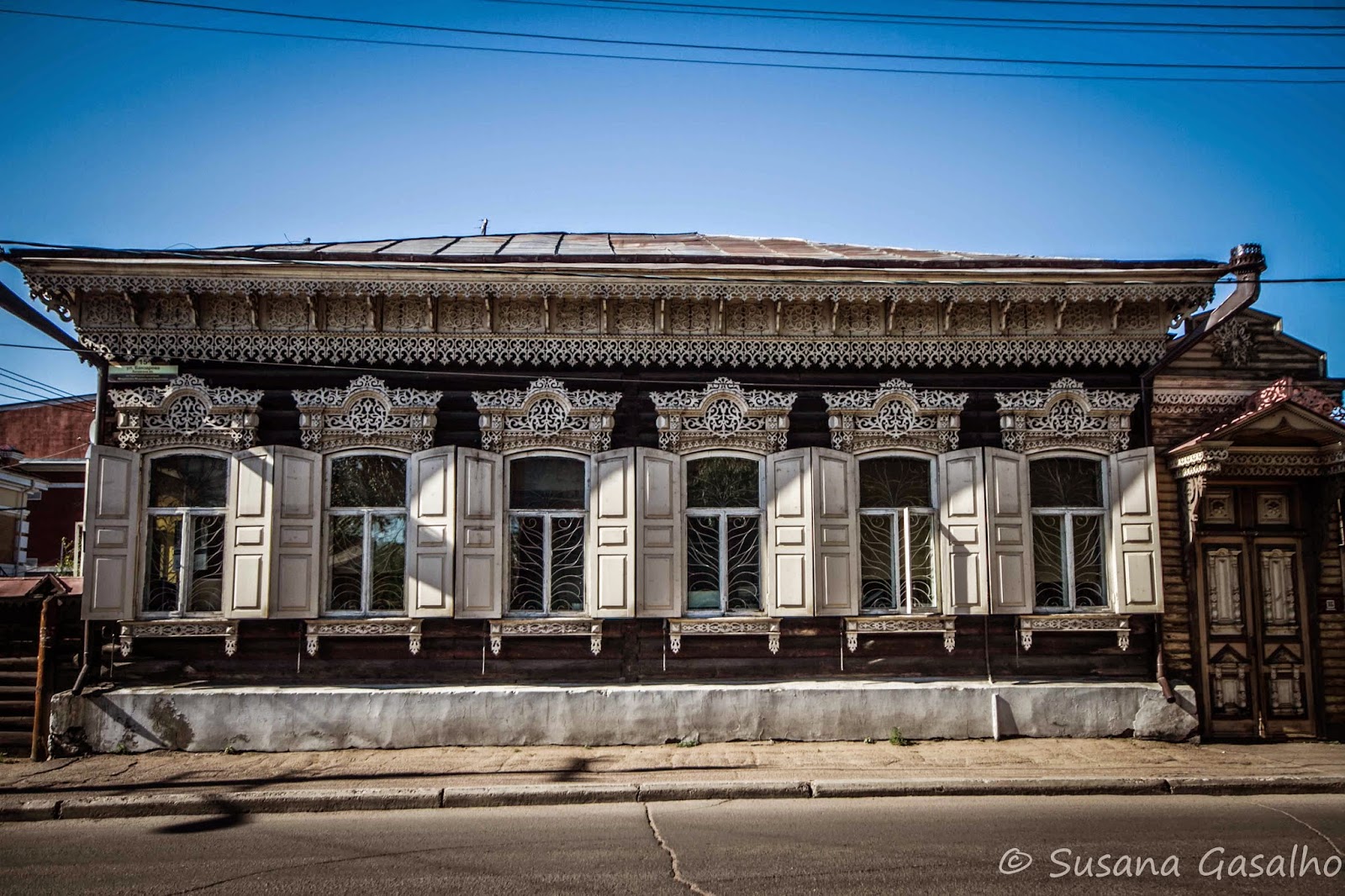
| Wooden house |
![]() |
| Detail of a wooden house |
![]() |
| Ivolginsky Datsan |
![]() |
| Wooden house |
ULAN-UDE
Ulan-Ude (GMT+8). Vimos o Sol nascer e chegámos. Deixámos as
coisas no hostel e procurámos o que ver na cidade, observámos o mapa e
recolhemos a informação sobre que transportes apanhar para visitar o que
queremos.
Para além de querermos ver a cidade, o nosso
propósito era visitar um templo budista que está localizado a 2h da cidade. São
precisos apanhar 2 mini-carrinhas e foi bastante fácil encontrá-las. Um dos
mini-bus custou-nos 40 rublos (+/- 0,80 €) e o outro 20 rublos (+/- 0,40€) por
pessoa e só ida. Para pagar só temos de entregar o dinheiro às pessoas à nossa
frente e vai sendo passado até chegar ao motorista. O carro só parte quando
cheio.
O templo, localizado a 23 Km de Ulan-Ude,
chama-se Ivolginsky datsan. Fica perto da aldeia de Verkhnyaya Ivolga na região
da Buryatia, na Rússia. Sente-se uma grande paz e sossego no espaço que é
composto por vários pequenos templos. Senti-me um pouco como no filme “7 anos no
Tibete” pois os monges são naturalmente sorridentes e simpáticos. Divertem-se
com pequenas coisas. Vi um bastante jovem (uns 17 anos) a brincar com um cão e
gato. Quando o gato correu arreliado atrás do cão, o monge riu-se imenso
divertido, o que me fez rir também.
Na história deste datsan consta que em 1927 o 12º Pandito Hambo Lama, Dashi-Dorzho
Itigelov pediu aos seus estudantes e monges companheiros que enterrassem o seu
corpo depois da sua morte e que só o voltassem a verificar após 30 anos.
Segundo a história, Itigelov sentou-se então na posição de lótus, começou a
cantar a “oração da morte” e morreu a meio da meditação. Os monges seguiram
todas as suas indicações mas quando exumaram o seu corpo passados 30 anos,
ficaram espantados por descobrir que não tinha sinais de decomposição. Pelo
contrário, parecia que Itigilov tinha morrido apenas a algumas horas atrás. Com
medo da resposta Soviética ao sucedido, os monges enterraram novamente o corpo
numa campa anónima.
A história de Itigelov foi esquecida até dia 11
de Setembro de 2002, quando o corpo foi finalmente exumado e transferido para o
Ivolginsky datsan onde foi examinado por monges, cientistas e patologistas. A
declaração oficial diz que o corpo está muito bem preservado, sem sinais de
decomposição, ainda com os tecidos dos músculos e pele. O corpo nunca foi
embalsamado ou mumificado. Impressionante!
Já de volta a Ulan-Ude, capital da República de
Buryatia, região localizada na parte sul da Sibéria e que é parte da Rússia
desde 1920. (By the way, na Sibéria é normal conduzir-se com o volante de ambos
os lados embora as estradas estejam preparadas para a condução com o volante à
esquerda). Visitámos o Rinponche Bagsha datsan, localizado num ponto panorâmico
onde se pode ter uma bela vista para a cidade. É um famoso centro budista
rodeado de natureza e com a maior estátua do Buda da Rússia. Mede 5 metros e é
feita de madeira do Brasil. É fácil e barato de chegar lá com o mini-bus nº 97
que parte da praça principal.
É um local muito pacífico com boa energia. Uma
senhora que lá trabalha chamou-nos para visitarmos um dos templos e tentou
explicar-nos (em chinês) os diferentes Budas presentes. Dedicou algum tempo a
mostrar-nos o espaço e a fazer-nos sentir a energia das estátuas e depois a
energia do Sol. Foi um bom momento!
Ao final do dia tivemos a nossa primeira
experiência com uma russa mal disposta. Talvez tenha sido um mal entendido
porque nunca chegámos a perceber qual era o problema, mas falou-nos de uma
forma zangada enquanto o seu companheiro encolhia os ombros e olhava para nós.
Regra geral, fomos sempre bem tratados pelos russos. Alguns abordavam-nos na
rua e cumprimentavam-nos simpaticamente.
No hostel (que fica localizado no centro, junto
à enorme e famosa cabeça gigante do Lenine) conhecemos outro casal francês que
faz o percurso na direcção oposta. Começaram em Myanmar e saltaram alguns
países pois o dinheiro já apertava mas foram, por exemplo, à Coreia do Norte
onde gastaram 950€ em 5 dias com uma tour organizada pois não há outra maneira
de lá ir. Perdemos algum tempo a falar sobre as suas impressões do país, do
quão organizado e artificialmente preparado para turistas está.
//
Ulan-Ude (GMT
+8). We saw the sun rise and arrived. We left our stuff in the hostel and searched
what to see in town, we observed the map and collect information about which
transports can take us where we want to visit.
In addition
to wanting to see the city, our purpose was to visit a Buddhist temple, which
is located 2 hours from the city. It takes 2 mini-vans and it was quite easy to
find them. One of the mini-buses cost us 40 rubles (+ / - 0,80 €) and another
20 rubles (+ / - 0,40 €) per person one-way. To pay we just have to give the
money to the people ahead of us and will be passed to reach the driver. The car
only leaves when full.
The temple,
located 23 Km from Ulan-Ude, called Ivolginsky datsan. It is near the village
of Verkhnyaya Ivolga the region of Buryatia, Russia. Feels great peace and
quiet in this place that consists of several small temples. I felt a bit like
the movie "7 years in Tibet" because the monks are naturally smiling
and friendly. Amuse themselves with little things. I saw a very young (about 17
years) playing with a dog and a cat. When teased the cat ran after the dog, the
monk laughed amused, which made me laugh too.
In the
history of this datsan states that in 1927 the 12th Pandito Hambo Lama
Dashi-Dorzho Itigelov asked his students and fellow monks to bury his body
after his death and that return to check after 30 years. According to history,
Itigelov then sat in the lotus position, started to sing the "Prayer of
Death" and died in the middle of meditation. The monks followed his wishes
and when his body was exhumed 30 years later, they were astonished to discover
that he had no signs of decomposition. Rather, it seemed that Itigilov had died
just a few hours ago. Afraid of the Soviet response to the succeeded, the monks
buried the body in an unmarked grave again.
The story of
Itigelov was forgotten until 11 September 2002 when the body was finally
exhumed and transferred to the Ivolginsky datsan where it was examined by
monks, scientists and pathologists. The official statement says that the body
is very well preserved, with no signs of decomposition, even with the tissues
of muscles and skin. The body was never embalmed or mummified. Impressive!
Now back to
Ulan-Ude, capital of the Republic of Buryatia, a region located in southern
Siberia and that is part of Russia since 1920. (By the way, in Siberia is
normal to drive with the steering wheel on both sides though roads are prepared
for driving with the steering wheel on the left). Visited the Rinponche Bagsha
datsan, located in a scenic spot where you can have a beautiful view of the
city. It is a famous Buddhist center surrounded by nature and with the largest
Buddha statue in Russia. Measures 5 meters and is made of wood from Brazil.
It's easy and cheap to get there with the mini-bus # 97 that departs from the
main square.
It is a very
peaceful place with good energy. A lady who works there called us to visit one
of the temples and tried to explain to us (in Chinese) the different Buddha
images there. Took some time to show us the space and making us feel the energy
of the statues and then the energy of the sun. It was a good moment!
At the end of
the day we had our first experience with an angry Russian. Maybe it was a
misunderstanding because we never realized what the problem was, but she spoke
to us in an angry manner while his companion shrugged and looked at us.
Generally, we were always treated well by the Russians. Some approached us on
the street and greeted us kindly.
In the hostel
(which is located downtown, next to the huge and famous giant head of Lenin)
met another French couple who make the journey in the opposite direction. They
started in Myanmar and then skipped some countries because the money was
already tight and went to North Korea where they spent € 950 in 5 days with an
organized tour because there is no other way to go there. We spent some time talking
about their impressions of the country, of how artificially organized and
prepared for tourists it is.
Etiquetas:
buddhism,
datsan,
desenho,
diarios da errância,
fotografia,
graphic diary,
photo sketching,
photography,
russia,
sketches,
temple,
transmongolian,
travel the world,
travels,
ulanude,
viagens
Local:
Ulan-Ude, Buryatia, Russia
quarta-feira, 27 de agosto de 2014
IRKUTSK - ULAN-UDE 456 KM (from 29.05 - 22:10 (local time) to 30.05 - 06:39 (local time)
![]() |
| Little girl in Irkutsk square |
![]() |
| Near the river - Irkutsk |
![]() |
| Lovers selfie - Irkutsk |
![]() |
| Late night in the trans-mongolian |
![]() |
| Arriving to Ulan-Ude |
![]() |
| Irkutsk square |
Depois de novas 7h de volta a Irkutsk e um
bom banho quente no hostel, fomos buscar o nosso passaporte já com o visto para
a Mongólia e o Zé conseguiu finalmente comprar o carregador para o portátil
(não foi fácil encontrar o sítio).
O comboio vai junto ao Baikal, dizem ser
uma linda viagem durante o dia, mas nós estamos a viajar de noite. Será uma
curta viagem neste comboio vazio, pois começou em Irkutsk.
Na nossa cabine só temos a companhia de
um holandês de 54 anos.
Chegou depois de nós, educado e
despachado, cumprimentou-nos e fez-se apresentar. Depressa comecámos a
conversar. Viaja sozinho durante 2 semanas porque sempre quis fazer
Moscovo-Pequim. Tem um ar jovem e uma t-shirt das “Aventuras do Tintim” que me
fez sorrir.
Perguntou se podíamos tirar o ferro a
meio das janelas que segura as cortinas. Anuímos espantados pois não sabíamos
que dava para o fazer. Com a vista mais ampla, aponta para a janela e diz-nos:
“Assim vê-se melhor. É para isto que elas cá estão!”
Contou-nos dos seus planos para as 2
semanas e que há sempre coisas que gostava de ver por mais tempo, ao que eu
disse: “O Mundo é enorme e nunca se consegue ver tudo o que queremos”.
Resposta: “Sim! E se pensares é esse o segredo da vida!”, disse com entusiasmo
e continuou a arrumar as coisas. Pouco depois: “É por isso que não é
aborrecida. Se conseguisses ver tudo não tinha tanta piada.”
Comprou 1 velho Land Rover que renovou e
quer viajar com ele até à Mongólia, mas este verão vai viajar com o filho até
Marrocos, numa espécie de test-drive.
Tem um projecto também: uma vez que viaja
muito em trabalho, a filha colocou-lhe uma pequena vaca de peluche na mala com
uma nota: “para que ele nunca esteja sozinho”. E agora ele tenta fotografar a
“little cow” em diversos países, locais e com diferentes pessoas. Estivemos a
ver as fotos e o projecto está mesmo muito engraçado pois quando ele conta a
história toda a gente quer participar nele. Tem fotos com soldados, grupos de
russos, crianças. Todas as fotos têm histórias interessantes por trás!
Fez-me realmente ver que só viajo há 3
semanas e tenho muito para ver e aprender.
//
After 7 new hours we are back to Irkutsk
and to a nice hot shower in the hostel, we got our passport with the mongolian visa
and Zé finally managed to buy the charger for his laptop (it was not easy to
find the place).
The train goes along the Baikal, it is said
to be a beautiful trip during the day, but we are traveling at night. It will
be a short trip in this empty train because it started in Irkutsk.
In our cabin we only have the company of
a 54 years Dutch.
He arrived after us, polite and expeditious,
greeted us and introduce himself. Quickly we started talking. Traveling alone
for 2 weeks because always wanted to travel from Moscow to Beijing. Youthful
and with a t-shirt "Adventures of Tintin" which made me smile.
Asked if he could get the curtains’ iron out.
We nodded amazed because we did not know that it was possible to take it. With
the widest view, pointing to the window he tells us: "This way you see
better. That's why it’s here!"
He told us about his plans for the 2
weeks and that there are always things he'd like to see longer, to which I
said: "The world is huge and never get to see everything we want."
Answer: "Yes! And if you think about it, that is the secret of life!"
Said enthusiastically and continued packing. Shortly afterward: "That's
why it's not boring. If you could see it all it wouldn’t be so fun."
He bought an old Land Rover which he renewed
and wants to travel in it to Mongolia, but this summer he will travel to
Morocco with hir son, a kind of test-drive.
He also has a project: He travels much for
work, his daughter put a small cow teddy inside teh suitcase with a note:
"for you to never be alone." And now he tries to shoot the
"little cow" in various countries, places and with different people.
We've seen the photos and the project is really funny because when he tells the
story everyone wants to participate. He has photos with soldiers, groups of Russians,
children. All photos have interesting stories behind!
It made me really realize that I’m only
traveling for 3 weeks and have so much to see and learn.
quinta-feira, 7 de agosto de 2014
Khuzir
![]() |
| Khuzir |
![]() |
| Prayers site, Shaman rock |
![]() |
| Khuzir road |
![]() |
| Shaman ritual |
![]() |
| Paths go apart |
![]() |
| High view point, Khuzir |
Khuzir (GMT+8).
Há sempre
dias de melhor ou pior humor, e quando se viaja não é excepção. Seja porque há
dias que as coisas não nos correm bem, ou porque não gostamos particularmente
de um sítio ou das pessoas que nos rodeiam naquele momento. Há sempre dias em
que não apetece ver ninguém ou não apetece falar com ninguém.
Uma das
coisas boas enquanto se viaja e se tem de conviver e partilhar espaços com
outras pessoas é aprendermos a ser realmente donos do nosso espaço. Podemos
sentar-nos numa cama a ler e não falar e ninguém nos irá julgar por isso. E se
o fizer, também não nos interessará muito pois amanhã já não estaremos no mesmo
sítio. É bom aprendermos a ouvir-nos e a dizer que não.
A música
é e sempre será uma grande ajuda nesses momentos. Consegue levantar-me o ânimo
e fazer-me deixar de sentir o coração pesado. Afinal, mesmo que nem sempre me
apeteça falar com alguém, tenho o privilégio de estar bem e num sítio que
escolhi para estar.
Hoje é o
nosso último dia na ilha. Fomos fazer mais uma
caminhada, desta vez até a um ponto alto
para podermos ter uma melhor vista de toda a ilha. O Léo e a Julie
acompanharam-nos pois eles iam prosseguir o caminho atravessando a ilha, até à
outra costa. Planearam passar uma ou duas noites na tenda, dormindo por onde
lhes apetecesse, e depois voltar a Khuzir.
No dia anterior tínhamos ido todos para uma das praias e
mergulhámo-nos nas águas geladas do lago na esperança que o dito popular esteja
certo e que ganhemos mais uns anos de vida!
Chegado
foi o momento em que literalmente os nossos caminhos se separavam: eles
continuavam em frente e nós viraríamos à direita para o monte. Despedimo-nos
dos nossos companheiros dos últimos dias desejando-lhes o melhor que a vida
lhes tem para oferecer e vimo-los desaparecer atrás das colinas verdes de
Olkhon.
Nós
ficámos a contemplar a vista sobre a ilha, de um lado o lago, do outro uma
densa floresta de pinheiros, e ao longe a cidade principal. O tempo incerto
fez-se notar hoje novamente. Fez calor, depois veio um vento terrivelmente frio
que trouxe alguns chuviscos que depressa passaram para o céu voltar a abrir e o
sol aquecer-nos.
Os
pássaros e insectos passavam à nossa volta nas suas atarefadas vidas e era só
isso que se ouvia: os cantares suaves, zumbidos breves e o vento. Uma vez por
outra, sentia-se um carro que passava ao fundo, na estrada que vem de sul.
No
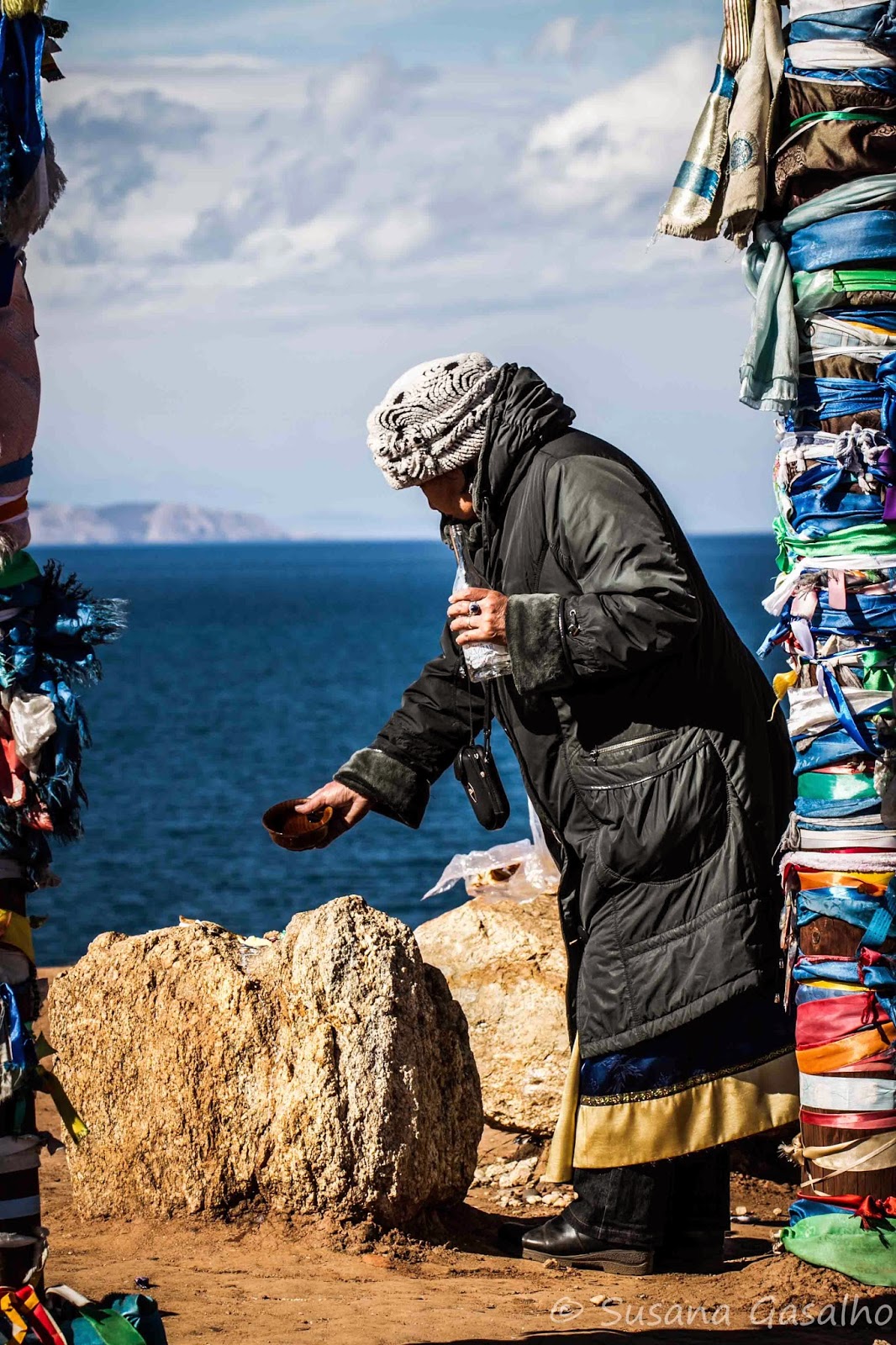
regresso à cidade fomos até à Rocha do Xamã para ver se víamos as marmotas e
deparámo-nos com um ritual xamã que ficámos a observar. Todos estavam em grupo
junto ao local de oração (uns paus em fila e ao alto com fitas atadas à volta e
pedras grandes alinhadas em frente destes) e comiam animadamente e partilhavam
comida. Depois (e sem percebermos a ordem) deitavam leite e vodka para uma
fogueira, punham uma moeda em cima de uma das pedras e seguidamente alguma
comida e mais leite e vodka. Também pronunciavam palavras enquanto o faziam, e
depois atavam fitas à volta dos paus.
Ficámos
ali tanto tempo a observar que nos vieram oferecer comida também. Sem sabermos
bem o que fazer, acabámos por deixar a nossa parte de oferenda numa pedra e
prosseguimos caminho.
Coincidência
ou não, o céu cinzento abriu-se e o sol surgiu enquanto eles ali estiveram...
//
There are always days with a better or worse mood, and when traveling is
no exception. Either because there are days when things are not going well or
because we do not necessarily like a place, or the people around us at that
moment. There are always days when you do not feel like seeing anyone or do not
feel like talking to anyone.
One of the good things while traveling and have to socialize and share the
spaces with others is learning to truly own our space. We can sit in the bed
reading and not talk and no one will judge you for it. And if someone does, it does
not matter much because tomorrow we are no longer in the same place. It's good
to learn to listen to us and say no.
Music is and always will be a great help on these times. Gets me with
better mood and makes me stop feeling such a heavy heart. After all, even if not
always feel like talking to someone, I have the privilege of being well and on the
place I have chosen to be.
Today is our last day on the island. We did one more walk, this time to
a high point in order to have a better view of the whole island. Leo and Julie
accompanied us they were going to continue the way across the island to the opposite
shore. They planned to spend one or two nights in the tent, sleeping where they
sprang, and then return to Khuzir.
The day before we had gone all to one of the beaches and dive in the icy
waters of the lake with the hope that the saying is right and we win a few more
years of life!
The moment our paths diverged, literally, arrived: they continued
forward and we turned right to the hill. We said goodbye to our fellows from the
last days wishing them the best that life has to offer them and saw them
disappear behind the hills of Olkhon.
We fell to admire the view of the island, on one side the lake, on the
other a dense pine forest, and the main town far down. The uncertain weather
became noted again today. It was hot, then came a bitter cold wind that brought
drizzle that quickly went back to open sky and the sun warm us.
The birds and insects passed around us in their busy lives and that was
all that was heard: the soft singing, brief tinnitus and the wind. Once in a
while, we heard a passing car in the background, on the road from the south.
Returning to town we went to the Shaman Rock to look for marmots and we
faced a shaman ritual and stopped there watching. Everyone gathered in the
place of prayer (a few wooden bars in a row tied around with silk cloths and
great stones lined up in front of these) and ate happily and shared food. After
(and without realizing the order) lay milk and vodka to a fire, they put a coin
on top of one of the stones and then some food and more milk and vodka. Also
pronouncing words as they did this, and then they tied ribbons around the poles.
We stayed there so long watching that some of them came to offer us food
too. Without knowing what to do, we ended up leaving our part of offering on a
stone and proceed.
Coincidence or not, the gray skies opened up and the sun came up while
they were there...
Etiquetas:
Baikal,
diarios da errância,
graphic diary,
Khuzir,
landscape,
Olkhon,
photo sketching,
photography,
russia,
transmongolian,
travel,
viagens
Local:
Khuzhir, Buryatia, Russia
domingo, 13 de julho de 2014
Olkhon Island, 24-28.05.2014
![]() |
| Lake Baikal from Olkhon in the evening |
![]() |
| Shaman rock and a prayer's point |
![]() |
| Lake Baikal |
![]() |
| Digging a hole for our couchsurfing host |
![]() |
| Our home for a few days |
![]() |
| Beach on the island |
![]() |
| View to lake Baikal |
![]() |
| Lake Baikal from Olkhon island |
![]() |
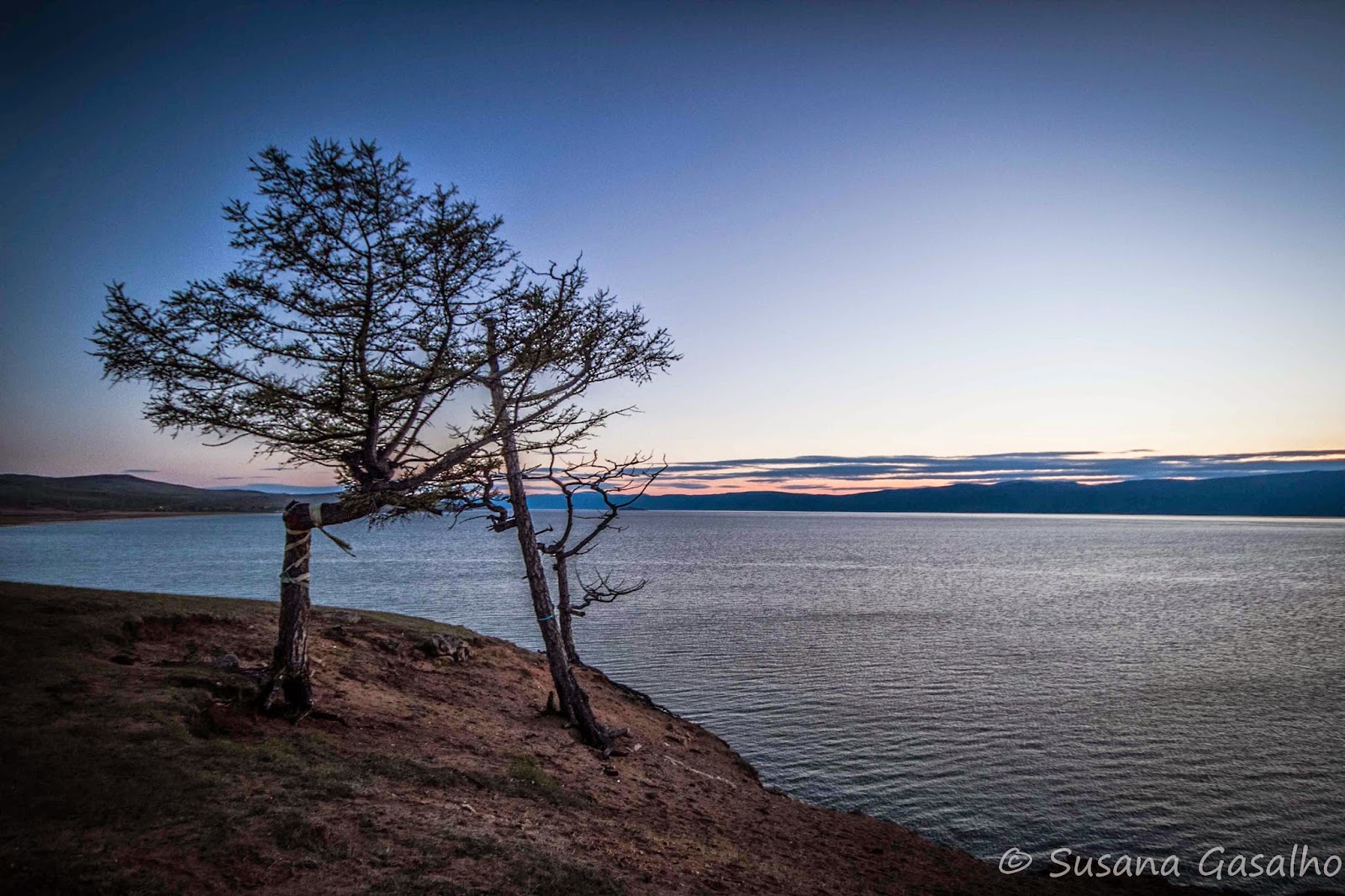
| Pine trees |
![]() |
| Shaman rock |
Olkhon é
a maior das ilhas do lago Baikal com 71,5 Km de comprimento e 20,8 Km de
largura. Os mongóis crêem que, segundo antigas lendas, ela é o centro do universo.
É grande
o suficiente para ter os seus próprios lagos e é composta por suaves colinas (o
ponto mais alto, Monte Zhima, tem 818m acima do nível das águas do lago),
estepes e uma densa floresta na parte Nordeste da ilha.
Tem
algumas longas praias de areia, mas noutros locais a terra acaba abruptamente
no lago, o que lhe confere uma atmosfera selvagem e intacta, com belas
paisagens sobre as águas límpidas.
O lago
Baikal, localizado no sul da Siberia, tem 25 milhões de anos e é o maior lago
de água doce do mundo. Contém aproximadamente 22% de todas as reservas de água
doce (não gelada) do mundo e é o mais profundo lago do planeta (1640m). Está
também entre os lagos com as águas mais límpidas, tendo uma flora e fauna muito
ricas: mais de 3500 espécies das quais ¾ são endémicas. Foi declarado
Património do Mundo pela UNESCO em 1996.
Está
completamente rodeado por montanhas e alberga também os Buryat, uma tribo que
reside no lado leste do lago de origem mongol (provavelmente descendetes do
Genghis Khan).
No
Inverno o lago gela e é possível caminhar sobre ele e fazerem-se desportos da
estação assim como alugar trenós puxados por cães.
Nós
ficámos 4 dias na ilha, em casa de um russo que, gentilmente, oferece um espaço
para dormir e cozinhar em troca de alguns trabalhos, no nosso caso, ele
precisava de gente para cavar um buraco para uma nova “casa-de-banho”.
No mesmo
espaço estiveram connosco o Léo e a Julie, outro casal francês e um casal
alemão que viaja pelo mundo. A cidade principal da ilha, Khuzir, tem 2 pequenos
mercados com produtos obviamente caros por serem escassos e alguns hotéis. As
estradas não são pavimentadas, só o hotel principal tem canalizações, de resto
a água utilizada pelos locais é recolhida no lago, e as vacas deambulam
livremente na sua busca por alimento.
Há alguns
locais que organizam tours e actividades mas é dificil perceber o horário de
funcionamento das coisas, e o hotel principal (Nikita’s) parece ter o monopólio
das actividades da ilha.
//
Olkhon is
the largest island of Baikal Lake with 71.5 km long and 20.8 km wide.
Mongolians believe that, according to ancient legends, it is the center of the
universe.
It's big
enough to have its own lakes and consists of rolling hills (the highest point,
Mount Zhima, is 818m above the lake’s water level), and a dense forest steppe
in the Northeastern part of the island.
It has
some long sandy beaches, but at some places the land ends abruptly at the lake,
giving it a wild and unspoilt atmosphere, with wonderful views over the clear
waters.
The
Baikal Lake, located in southern Siberia, is 25 million years old and is the
largest freshwater lake in the world. Contains approximately 22% of all
freshwater bodies (not icy) in the world and is the deepest lake in the world
(1640m). It is also among the lakes with most clear water, having a very rich
flora and fauna: over 3500 species of which ¾ are endemic. It was declared UNESCO World Heritage in 1996.
Is
completely surrounded by mountains and also houses the Buryat, a tribe that
lives on the east side of the lake, of Mongolian origin (probably descendetes
of Genghis Khan).
In winter
the lake freezes and you can walk on it and make season sports as well as rent
dogsleds.
We stayed
for four days on the island, in the home of a Russian who kindly offers a space
to sleep and cook in exchange for some work. In our case he needed people to
dig a hole for a new "toilet".
In the same
space were with us, Leo and Julie, another French couple and a German couple
who travel the world. The island's main town, Khuzir, has 2 small markets with
obviously expensive products because they are scarce and some hotels. The roads
are not paved, only the main hotel has plumbing, moreover the water used is by
the locals is collected from the lake, and cows roam freely in their search for
food.
There are
some places that organize tours and activities but it is hard to understand the
working hours of things, and the main hotel (Nikita's) seems to have a monopoly
on island activities.
Irkutsk and application for the Mongolian Visa
![]() |
| teenage girl dressed for her graduation day |
![]() |
| Typical Siberian wooden house |
![]() |
| The minibus to Olkhon Island |
![]() |
| Street view where the minibuses stopped to get passengers |
Irkutsk
(GMT +8). Chegámos às 9h38 (hora local). Nós e o Paul descemos do comboio e
procurámos na plataforma o Léo e a Julie. Quando nos encontrámos lá seguimos os
5.
Novamente
por coincidência, nós e o Paul tínhamos reservado o mesmo hostel, e como o Léo
e a Julie não tinham reservado nada, encaminhámo-nos todos para lá a fim de ver
se haveriam mais duas camas disponíveis.
Acabámos,
portanto, por ficar todos juntos no mesmo dormitório!
O que
dizer de Irkutsk? Penso que a parte mais interessante da cidade não é o seu
centro, bem arranjado e organizado com jardins bonitos, mas as velhas casas de
madeira trabalhada com recortes junto ao telhado que as faz parecer terem sido
feitas em croché. Algumas das casas estão inclinadas, como que a madeira tenha
dado de si, mas são habitadas.
Também
nos foi recomendado no hostel um pequeno restaurante onde poderíamos comer pozi, um prato bastante tipico da
Sibéria. Nesse local foi realmente barato e pudémos observar os russos a
comerem-nos à mão (como deve de ser) e a beberem shots de vodka seguidos de
goles no sumo de tomate.
Em
Irkutsk aproveitámos para ir à Embaixada da Mongólia para pedir o visto. Não
foram necessárias grandes burocracias, apenas preencher o impresso que nos
deram no momento e entregar 1 foto tipo passe e 1 fotocópia do passaporte,
assim como deixar lá o original, como é óbvio. Nada de perguntas sobre o
itinerário ou sobre bilhetes de entrada e saída do país!
Tivemos,
por fim, de ir pagar o custo do visto directamente ao banco mais próximo. O
nosso visto custou-nos à volta de 50 euros pois tivémos de pagar para ficar
pronto em 5 dias úteis. O normal é demorar uma semana e custa à volta de 35
euros. Há ainda uma opção mais cara para ficar pronto em 2 dias úteis. A
embaixada é no centro e fecha às quartas e fins-de-semana. Para fazer o visto
só é possível ir lá da parte da manhã (até às 13h).
Depois
disso tratado, seguimos com o Léo e Julie até à estação dos autocarros para
tentar comprar bilhetes para a ilha de Olkhon. A quarta maior ilha do mundo
rodeada por um lago e seguramente a maior ilha das mais de 27 do lago Baikal,
no Sul da Sibéria, com uma área de 730 km2.
Não foi
tarefa fácil, uma vez que ninguém falava inglês e todos apontavam para algum
lugar que não percebíamos e nos diziam que o bus era no dia seguinte “Tomorrow!
Tomorrow!”.
Bem, isso
nós sabíamos! Obrigada! Queríamos era ter os bilhetes já comprados, mas como
nos pareceu impossível, optámos por uma volta à cidade e fomos procurar também
uma loja que vendesse carregadores do portátil, para substituir o que o Zé
esqueceu em Moscovo!
Entretanto
chovia e encontrámos um grupo de adolescentes bem vestidos, de faixa ao peito.
Perguntámos-lhes indicações e no fim acabámos a tirar fotos com eles, pois
todos queriam fotos com os primeiros turistas com quem falavam! Só um deles
falava melhor inglês, portanto foi bastante extenuante toda a informação e
excitação vinda daqueles miúdos de 15 anos que, conseguimos perceber depois,
estavam assim vestidos pois era o seu último dia de escola. Eram finalistas!
Eles
acompanharam-nos por bastantes quilómetros até à estação de autocarros (de
novo!), pois diziam que nos ajudavam com a compra dos bilhetes. Mas depois de
quarteirões e quarteirões a responder a mil perguntas sem sentido e a tirar
fotos, a estação já estava fechada, não encontrámos o carregador, estávamos
molhados e cansados.
Voltámos
para o hostel exaustos e por isso, e depois de 3 dias no comboio, um banho
quente soube divinamente bem! Jantámos umas bolas de massa e carne que
comprámos no mercado e que, supostamente, são típicas mas cozinhámos da maneira
errada (segundo o senhor do hostel...mas para nós estavam muito boas!) pois
devem ser cozinhadas ao vapor e não na água a ferver como fizémos.
Bem,
depois disto tudo, no dia seguinte acordámos às 6h, despedimo-nos do Paul, que
prossegue viagem sozinho, e fomos com o casal francês até à estação de
autocarros onde, depois de algum tempo, conseguímos perceber de onde arrancavam
as mini-caravanas para Kuzhir (cidade principal da ilha). Pagámos 700 rublos (à
volta de 14 euros) por pessoa para ir e dividimos a viagem com outras pessoas
russas que foram enchendo o carro. A viagem foi longa (7h) e quase sempre em
estradas de terra batida. O carro ia carregado com mercadorias que levariam
para Olkhon.
//
Irkutsk (GMT +8). We arrived at 9:38 a.m.
(local time). We and Paul got off the train and on the platform looked for Leo
and Julie. When we met them, we carried on.
Again coincidentally, we and Paul had
booked the same hostel, and how Leo and Julie had not booked anything, we all
headed there to check if there would be two more beds available.
At the end, we all stayed together in the
same dorm!
What about Irkutsk? I think the most
interesting part of the city is not its center, well arranged and organized
with beautiful gardens, but the old wodden houses carved with cutouts along the
roof that makes them seem to have been made in crocheted. Some of the houses
are inclined, like as some of the wood had falled, but are inhabited.
We were also recommended at the hostel to
go to a small restaurant where we could eat pozi, the typical dumplings in
Siberia. This place was really cheap and we could see the Russians eat the pozi
by hand (as it should be) and drinking shots of vodka followed by gulps in
tomato juice.
In Irkutsk we took the opportunity to go
to the Embassy of Mongolia to apply for a visa. There was no need for too much bureaucracies,
just fill out the form they give us there and handing 1 passport photo and 1
photocopy of the passport, and leave the original, of course. No questions
about the itinerary or entry ticket
or way out from the country!
Finally, we had to go to the nearest bank
to pay the visa fee. Our visa cost
us around 50 euros because we had to pay to get it ready in 5 business days.
The normal is to take a week and costs around 35 euros. There is still a more
expensive option to be ready in 2 days. The embassy is in the center and closes
on Wednesdays and weekends. To make the visa, can only go there in the morning
(up to 13h).
After this, we followed with Leo and
Julie to the bus station to try to buy tickets to Olkhon island. The fourth
largest island in the world surrounded by a lake and certainly the largest
island of over 27 at Lake Baikal in southern Siberia, with an area of 730 km2.
It was not easy, since no one spoke
English and all pointed to somewhere that we did not understood, we were told
that the bus was the next day after "Tomorrow! Tomorrow ".
Well, that we knew! Thank you! We just wanted
to have the tickets already purchased, but as it seemed impossible to us, we
opted to go back to the city center and also look for a store that could sell
laptop chargers, to replace the one Ze forgot in Moscow!
Meanwhile it rained and we found a group
of teenagers well dressed, with a strip on their chest. Asked them directions and at the end we
ended up taking pictures with them, because everyone wanted pictures with the
first tourists who they spoke with! One of them spoke better English, so it was
quite exhausting all the information and excitement of those 15 year old kids,
we could realize later they were dressed like that because it was their last
day of school. They were graduated!
They followed us for quite a few
kilometers to the bus station (again!), they said that helped us with the
purchase of tickets. But after blocks and blocks answering a thousand nonsense questions
and taking pictures, the station was already closed, we did not find the charger,
we were wet and tired.
We returned to the hostel exhausted, and
after three days on the train, a hot bath felt divine! We dinned a few balls of
dough and meat bought in the market and it was supposed to be typical but we
cooked it the wrong way (according to the guy from the hostel... but for us it
was very good!) It must be cooked to vapor and not boiled in water as we have
done.
Well, after all this, the next day we
woke up at 6am, said goodbye to Paul, who continued on alone, and went with the
French couple to the bus station where, after some time, we could find the
place from which the mini-caravans depart for Kuzhir (main town on the island).
We paid 700 rubles (around 14 euros) per person to go and share the trip with
other Russian people who were filling the car. The trip was long (7 hours) and
almost always on dirt roads. The car was loaded with goods which would supply
Olkhon.
Etiquetas:
Baikal,
diarios da errância,
Irkutsk,
island,
Khuzir,
lake,
Olkhon,
photo sketching,
photography,
russia,
sketches,
transmongolian,
travel,
travel the world,
viagem,
viagens
Subscrever:
Mensagens (Atom)