Mostrar mensagens com a etiqueta travels. Mostrar todas as mensagens

sexta-feira, 20 de março de 2015

Hampi


Monkeys on the climb to Matanga Hill

 Details of Hampi

The wonderful view from Matang Hill. The picturesque sight from the top comprises the Tungabhadra River, the Kodanda Rama temple, the Veerbhadra temple and the Turthu canal.
Stone chariot in the Vithala Temple Complex
Worker keeping the floor clean of weeds
Vithala Temple Complex
Stepped tank
Lotus Temple
José sketching at Elephant Stables
          
Steps of the Mahanavami Dibba pyramid
Streets of Hampi

Making offerings to the gods. Being grateful for the water.
Sunset at Hemakuta Hill
Elephant Stables
View to  Virupaksha Temple
Woman in a small village near Hampi
Boy selling postcards and guides that stopped to talk with us 
Chegámos a Hampi às 7h30 da manhã, depois de 8h30 no sleeper bus que nos surpreendeu pela positiva! De um lado do autocarro tem camas de casal e do outro camas individuais, todas com portas de correr para se ter alguma privacidade e descanso. Este autocarro tinha inclusive fichas de electricidade e a nível de higiene não estava tão mau como poderíamos espectar! 
A esta altura da viagem, reflectimos sobre o nosso percurso na Índia, mas ainda não conseguimos perceber se gostamos dela ou não. Há muito que aprender e ver ainda para se reflectir sobre este ambiente em que a Índia nos envolve, as suas pessoas e todos os estrangeiros que a procuram por diversos motivos, desde a espiritualidade, até aprendizagem, interiorizações, buscas pessoais, novos começos...há de tudo. Conhecemos pessoas que vieram à Índia por um curto período e acabaram por voltar para aprofundar o seu yoga ou simplesmente para ficarem mais tempo num local que gostaram. Outras deixaram tudo para trás, foram viver para um ashram, sem dinheiro ou posses e algumas enfrentam dificuldades para sair agora dessa opção.
Mas Hampi pareceu-nos um local onde se pode ficar por meses, sendo, no entanto, uma pequena aldeia de terra batida e poucas infra-estruturas. Foi por isso fácil deitar cedo e acordar com o Sol para percorrer as ruas estreitas mas cheias de lojas de artesanato e vestuário, ou tomar o pequeno-almoço num dos agradáveis terraços com almofadas e mesas no chão para ficarmos a relaxar ao ritmo suave de Hampi.
Ali senti-me a aprender a ouvir ainda melhor o meu corpo, a criar um ritmo que gostaria de ter e que sei ser difícil em países com distracções nocturnas ou no nosso, com amigos para encontrar ao fim do dia e fins-de-semana, internet e tv. 
Mas passar por estas experiências também nos faz querermos mudar algumas coisas no nosso ritmo e fazer alterações ao nosso estilo de vida, sabendo do que é necessário prescindir para estarmos melhor.
Descobrimos Hampi porque alguém com quem falámos nos recomendou e, apesar do desvio, valeu a pena! É um dos locais Património da Humanidade da UNESCO e fica localizada no estado de Karnataka. 
Entre os seus montes e vales, o que caracteriza o local são os seus mais de 500 monumentos e ruínas a visitar de bicicleta ou tuk-tuk. Os mais próximos da vila visitam-se a pé, passando por rebanhos de ovelhas e cabras e macacos brincalhões (que estão por todo o lado). Há bastantes locais com maravilhosas vistas para as ruínas e de onde se observa o pôr e o nascer do Sol.
Foi um encanto para nós percorrer aquelas ruínas, observar tudo com atenção e subir a lugares altos para ver as vistas. Sentia-se o sossego e podíamos ficar horas sentados a contemplar...
Como todos os locais na índia, Hampi também é feita das pessoas que lá vivem. Algumas podem ser um pouco intrometidas porque querem vender algo (ou na sua loja ou uma tour de tuk-tuk ou bicicleta, ou até mesmo crianças cheias de lábia que vendem postais e guias), mas outras não têm qualquer interesse senão estar um pouco connosco a conversar ou partilhar um momento, e é dessas que melhor recordamos...
Hampi fica na memória pelo seu estilo de vida tranquilo e ritmo diário sereno. Cheia de cantos que nunca conheceremos, infindáveis detalhes nas suas imensas ruínas de palácios, mercados, pavilhões e palácios reais, monumentos, estátuas... e incontáveis pores-do-Sol.

//

We arrived in Hampi at 7:30 am, after 8:30 on the sleeper bus that surprised us positively! On one side of the bus it has double beds and on the other side, single beds, all with sliding doors to have some privacy and allow us to rest. This bus had electricity and hygiene level was not as bad as we could expect!
At this point of the trip, we reflected on our journey in India, but we still have to decide if we like it or not. There is still much to learn and see so we could think about this environment that surrounds us, its people and all foreigners who come to India for various reasons, from spirituality, to learning, personal searches, new beginnings... We can find all the reasons! We know people who came to India for just a short period and eventually they returned to deepen their yoga or just to spend more time in a place they loved. Other left everything behind, went to live in an ashram, without money or possessions and some are now struggling to get out of that option.
But Hampi seemed to us a place where we could stay for months even if it's a small village of dirty roads and almost no infrastructures. 
It was so easy to go to bed early and wake up with the Sun to go through the narrow streets full of craft shops and clothing stores, or to take breakfast in one of the nice terraces with tables and cushions on the floor. Just relaxing in the smooth rhythm of Hampi .
There I felt learning to hear even better my body, creating a rhythm that I would like to have and which I know is difficult in countries with night distractions or in our own country, where our friends live and meet us in the evenings and weekends, or where we have internet and tv.
But go through these experiences also makes us wanting to change some things at our pace and make changes to our lifestyle, knowing what is necessary to leave behind for being better.
We found Hampi because someone we spoke to recommended it to us and despite the deviation on the way, it was worth it! It is one of the UNESCO heritage sites of the World and is located in the state of Karnataka.
Among its hills and valleys, what characterizes the place are its more than 500 monuments and ruins to visit by bike or tuk-tuk. The nearest to the village can be visited on foot, passing flocks of sheeps and goats and playful monkeys (which are everywhere). There are plenty of places with wonderful views of the ruins and where we can see the sunset and the sunrise.
It was a charm for us navigate those ruins, observe everything carefully and climb to high places to see the sights. We could feel the quietness and spend hours seated just contemplating...
Like all places in India, Hampi is also made of the people who live there. Some may be a bit nosy because they want to sell something (or in their store or some tuk-tuk or bicycle tour, or even children selling postcards and guides), but others have no interest but be a little with us to talk or share a moment, and it is these people that we better remember...

Hampi stays in memory for its peaceful lifestyle and serene daily rhythm. Full of corners that we will never know, endless details in its immense ruins of palaces, markets, pavilions, royal palaces, monuments and statues...and countless sunsets.

segunda-feira, 8 de setembro de 2014

ULAN-UDE (Last Russian stop)

Ivolginsky temple
Rinponche Bagsha datsan
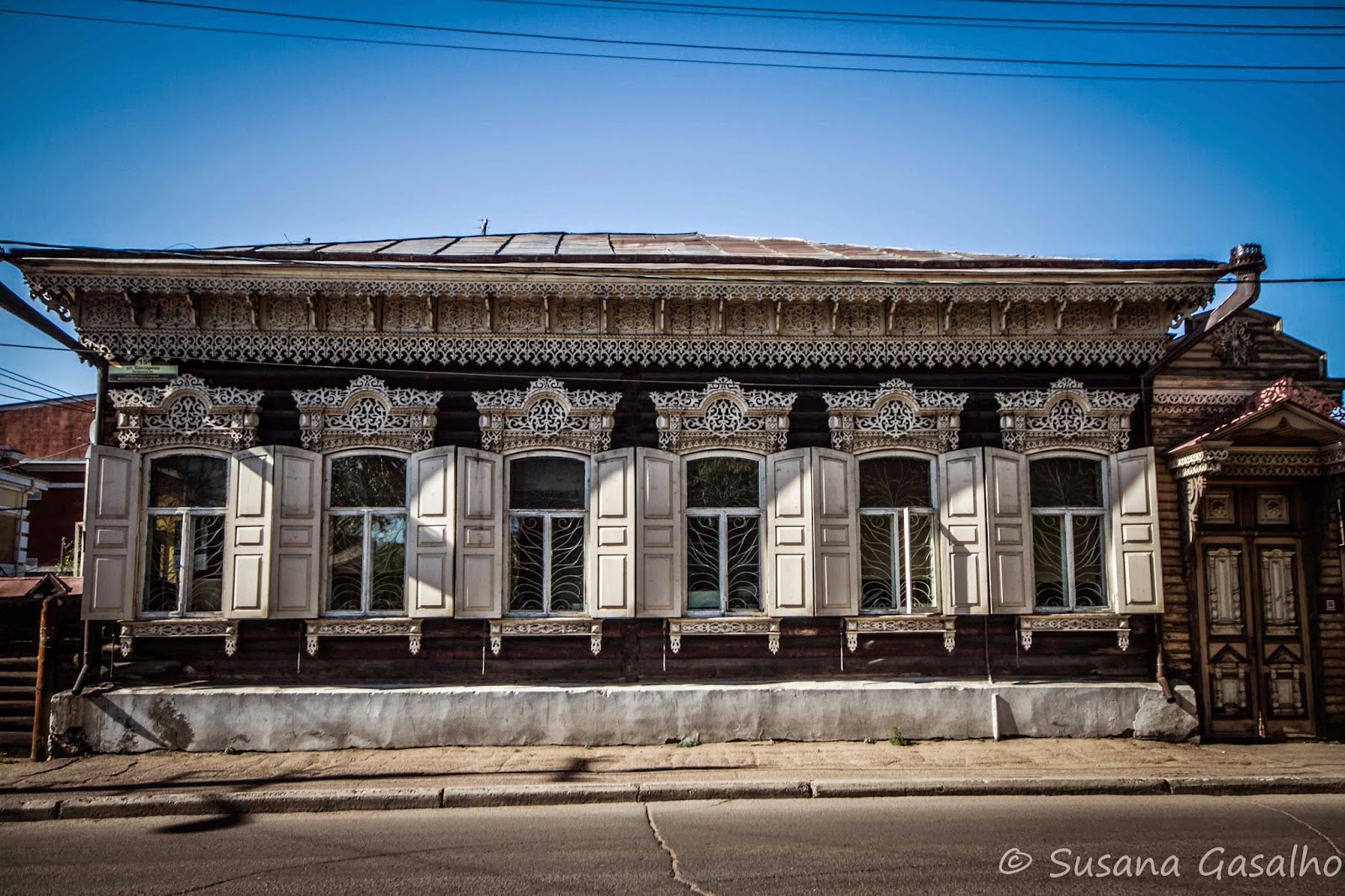
Wooden house
Detail of a wooden house
Ivolginsky Datsan
Wooden house
ULAN-UDE
Ulan-Ude (GMT+8). Vimos o Sol nascer e chegámos. Deixámos as coisas no hostel e procurámos o que ver na cidade, observámos o mapa e recolhemos a informação sobre que transportes apanhar para visitar o que queremos.
Para além de querermos ver a cidade, o nosso propósito era visitar um templo budista que está localizado a 2h da cidade. São precisos apanhar 2 mini-carrinhas e foi bastante fácil encontrá-las. Um dos mini-bus custou-nos 40 rublos (+/- 0,80 €) e o outro 20 rublos (+/- 0,40€) por pessoa e só ida. Para pagar só temos de entregar o dinheiro às pessoas à nossa frente e vai sendo passado até chegar ao motorista. O carro só parte quando cheio.
O templo, localizado a 23 Km de Ulan-Ude, chama-se Ivolginsky datsan. Fica perto da aldeia de Verkhnyaya Ivolga na região da Buryatia, na Rússia. Sente-se uma grande paz e sossego no espaço que é composto por vários pequenos templos. Senti-me um pouco como no filme “7 anos no Tibete” pois os monges são naturalmente sorridentes e simpáticos. Divertem-se com pequenas coisas. Vi um bastante jovem (uns 17 anos) a brincar com um cão e gato. Quando o gato correu arreliado atrás do cão, o monge riu-se imenso divertido, o que me fez rir também.
Na história deste datsan consta que em 1927 o 12º Pandito Hambo Lama, Dashi-Dorzho Itigelov pediu aos seus estudantes e monges companheiros que enterrassem o seu corpo depois da sua morte e que só o voltassem a verificar após 30 anos. Segundo a história, Itigelov sentou-se então na posição de lótus, começou a cantar a “oração da morte” e morreu a meio da meditação. Os monges seguiram todas as suas indicações mas quando exumaram o seu corpo passados 30 anos, ficaram espantados por descobrir que não tinha sinais de decomposição. Pelo contrário, parecia que Itigilov tinha morrido apenas a algumas horas atrás. Com medo da resposta Soviética ao sucedido, os monges enterraram novamente o corpo numa campa anónima.
A história de Itigelov foi esquecida até dia 11 de Setembro de 2002, quando o corpo foi finalmente exumado e transferido para o Ivolginsky datsan onde foi examinado por monges, cientistas e patologistas. A declaração oficial diz que o corpo está muito bem preservado, sem sinais de decomposição, ainda com os tecidos dos músculos e pele. O corpo nunca foi embalsamado ou mumificado. Impressionante!
Já de volta a Ulan-Ude, capital da República de Buryatia, região localizada na parte sul da Sibéria e que é parte da Rússia desde 1920. (By the way, na Sibéria é normal conduzir-se com o volante de ambos os lados embora as estradas estejam preparadas para a condução com o volante à esquerda). Visitámos o Rinponche Bagsha datsan, localizado num ponto panorâmico onde se pode ter uma bela vista para a cidade. É um famoso centro budista rodeado de natureza e com a maior estátua do Buda da Rússia. Mede 5 metros e é feita de madeira do Brasil. É fácil e barato de chegar lá com o mini-bus nº 97 que parte da praça principal.
É um local muito pacífico com boa energia. Uma senhora que lá trabalha chamou-nos para visitarmos um dos templos e tentou explicar-nos (em chinês) os diferentes Budas presentes. Dedicou algum tempo a mostrar-nos o espaço e a fazer-nos sentir a energia das estátuas e depois a energia do Sol. Foi um bom momento!
Ao final do dia tivemos a nossa primeira experiência com uma russa mal disposta. Talvez tenha sido um mal entendido porque nunca chegámos a perceber qual era o problema, mas falou-nos de uma forma zangada enquanto o seu companheiro encolhia os ombros e olhava para nós. Regra geral, fomos sempre bem tratados pelos russos. Alguns abordavam-nos na rua e cumprimentavam-nos simpaticamente.
No hostel (que fica localizado no centro, junto à enorme e famosa cabeça gigante do Lenine) conhecemos outro casal francês que faz o percurso na direcção oposta. Começaram em Myanmar e saltaram alguns países pois o dinheiro já apertava mas foram, por exemplo, à Coreia do Norte onde gastaram 950€ em 5 dias com uma tour organizada pois não há outra maneira de lá ir. Perdemos algum tempo a falar sobre as suas impressões do país, do quão organizado e artificialmente preparado para turistas está.

//

Ulan-Ude (GMT +8). We saw the sun rise and arrived. We left our stuff in the hostel and searched what to see in town, we observed the map and collect information about which transports can take us where we want to visit.
In addition to wanting to see the city, our purpose was to visit a Buddhist temple, which is located 2 hours from the city. It takes 2 mini-vans and it was quite easy to find them. One of the mini-buses cost us 40 rubles (+ / - 0,80 €) and another 20 rubles (+ / - 0,40 €) per person one-way. To pay we just have to give the money to the people ahead of us and will be passed to reach the driver. The car only leaves when full.
The temple, located 23 Km from Ulan-Ude, called Ivolginsky datsan. It is near the village of Verkhnyaya Ivolga the region of Buryatia, Russia. Feels great peace and quiet in this place that consists of several small temples. I felt a bit like the movie "7 years in Tibet" because the monks are naturally smiling and friendly. Amuse themselves with little things. I saw a very young (about 17 years) playing with a dog and a cat. When teased the cat ran after the dog, the monk laughed amused, which made me laugh too.
In the history of this datsan states that in 1927 the 12th Pandito Hambo Lama Dashi-Dorzho Itigelov asked his students and fellow monks to bury his body after his death and that return to check after 30 years. According to history, Itigelov then sat in the lotus position, started to sing the "Prayer of Death" and died in the middle of meditation. The monks followed his wishes and when his body was exhumed 30 years later, they were astonished to discover that he had no signs of decomposition. Rather, it seemed that Itigilov had died just a few hours ago. Afraid of the Soviet response to the succeeded, the monks buried the body in an unmarked grave again.
The story of Itigelov was forgotten until 11 September 2002 when the body was finally exhumed and transferred to the Ivolginsky datsan where it was examined by monks, scientists and pathologists. The official statement says that the body is very well preserved, with no signs of decomposition, even with the tissues of muscles and skin. The body was never embalmed or mummified. Impressive!
Now back to Ulan-Ude, capital of the Republic of Buryatia, a region located in southern Siberia and that is part of Russia since 1920. (By the way, in Siberia is normal to drive with the steering wheel on both sides though roads are prepared for driving with the steering wheel on the left). Visited the Rinponche Bagsha datsan, located in a scenic spot where you can have a beautiful view of the city. It is a famous Buddhist center surrounded by nature and with the largest Buddha statue in Russia. Measures 5 meters and is made of wood from Brazil. It's easy and cheap to get there with the mini-bus # 97 that departs from the main square.
It is a very peaceful place with good energy. A lady who works there called us to visit one of the temples and tried to explain to us (in Chinese) the different Buddha images there. Took some time to show us the space and making us feel the energy of the statues and then the energy of the sun. It was a good moment!
At the end of the day we had our first experience with an angry Russian. Maybe it was a misunderstanding because we never realized what the problem was, but she spoke to us in an angry manner while his companion shrugged and looked at us. Generally, we were always treated well by the Russians. Some approached us on the street and greeted us kindly.
In the hostel (which is located downtown, next to the huge and famous giant head of Lenin) met another French couple who make the journey in the opposite direction. They started in Myanmar and then skipped some countries because the money was already tight and went to North Korea where they spent € 950 in 5 days with an organized tour because there is no other way to go there. We spent some time talking about their impressions of the country, of how artificially organized and prepared for tourists it is.

quarta-feira, 2 de julho de 2014

Ekaterinburg-Irkutsk (3374 Km. From 20May-22:17 (local time) to 23May-09:38 (local time) 3 nights on the train


De novo no comboio para Irkutsk. Serão 3 dias dentro dele. Aqui dentro perde-se a noção do tempo e das horas. Melhor: não as há para quem viaja dentro dele. Entramos numa cidade com determinada hora, saímos noutra com hora diferente e o comboio rege-se pela hora de Moscovo.
No momento em que escrevo são 22h50 em Lisboa, 1h50 em Moscovo, 3h50 em Ekaterimburgo (de onde acabámos de sair) e 6h50 em Irkutsk (para onde vamos). Não sei que horário seguir, já nem sei a que horas o sol nasce... O céu nunca fica realmente escuro e no comboio dorme-se e come-se às horas que nos apetece.
À medida que nos dirigimos para o interior e mais para Sul, as temperaturas começam a descer e o frio lá fora sente-se nos ossos. Dentro do comboio está sempre uma temperatura agradável.
Agora aprendemos que podemos consultar o percurso no comboio e o tempo de cada paragem em cada estação, o que varia bastante: às vezes o comboio pára por 1 minuto e outras por 60 minutos.
É possível fazer-se Moscovo-Irkutsk num só comboio. Serão à volta de 4 dias de viagem. Em Irkutsk apanha-se outro para a Mongólia. Mas há um infindável número de paragens pelo meio, e com tempo é possível sair nas que se quer e depois comprar o bilhete para a próxima. Para isso é necessário paciência e tempo, pois podem não nos compreender ou pode mesmo não haver lugar no próximo comboio.
Novo dia. Acordei confusa com as horas. São 16h em Irkutsk, 8h em Lisboa e 13h em Ekaterimburgo, logo 11h em Moscovo. Acho que me sinto nostálgica pelas horas passarem enquanto durmo e, quando acordo, sinto essa diferença a aumentar.
Todos dormem na minha cabine.
Entretanto o casal francês que conhecemos veio visitar-nos. Ficámos a conversar até os acompanharmos à carruagem deles, que fica no inicio do comboio (o oposto da nossa). Até brincamos dizendo que já devem estar noutro fuso horário!
Eles estão em 3ª classe, o que lhes dá menos privacidade que a 2ª, pois não há cabines fechadas. São 4 camas mais 2 opcionais junto à janela que quando não estão a ser usadas são cadeiras e uma mesa.
É interessante percorrer o comboio de uma ponta à outra e ver a diferença de pessoas e cheiros que o preenchem. Vêem-se mães com crianças, militares e pessoas mais pobres na 3ª classe.
Algumas pessoas com traços asiáticos, outras de tez mais escura e outras caucasianas.
No vagão restaurante vêem-se casais séniores que parecem viajar em 1ª classe (as cabines são só para 2 pessoas), e russos que bebem cerveja.
Foi engraçado termo-nos encontrado todos neste comboio, aos franceses que por coincidência estiveram no mesmo hostel que nós em Moscovo e ao Paul por calharmos na mesma cabine.
Novo dia. Encontrámo-nos no vagão restaurante para almoçar e experimentar alguma comida, e depois fui até à carruagem do Léo e Julie para tirar umas fotos. Tivemos sorte pois estão lá 3 homens do Uzbequistão que são bastante curiosos e conversadores. Quiseram ver os desenhos do Zé, depois um deles, o Murad, quis que ele o desenhasse e que eu o fotografasse, e por fim, e sem falar inglês, estávamos todos a beber vodka do país deles e a jogar às cartas.
Combinámos amanhã encontrar-nos em Irkutsk. Cedo (hora local) chegaremos lá. Estou a tentar manter-me no meu novo futuro horário e por isso vou obrigar-me a dormir.
//
Again on the train to Irkutsk. Will spend three days inside the train. In here you lose track of time. Better: there is none for those traveling by it. We entered in a city with a certain hour, we leave at another with a different time and the train is goes by Moscow time.
At the time of writing are 22h50 in Lisbon, in Moscow 1:50 a.m., 3:50 a.m. in Ekaterinburg (where we have just come out) and 6:50 a.m. in Irkutsk (where we go to). I do not know what time should I follow, do not even know what time the sun rises... The sky never really gets dark and in the train we sleep and eat when we feel like.
As we head inland and further south, the temperatures begin to fall and we can feel the cold in our bones. Inside the train is always a pleasant temperature.
Now we learn that we can see the route on the train and the time of each stop in each station, which varies greatly: sometimes the train stops for 1 minute and the other for 60 minutes.
It is possible to make a single Irkutsk-Moscow train. It is a 4 days trip. Picking up another train to Mongólia in Irkutsk. But there are an endless number of stops in the middle, and with time you can stop wherever you want and then buy the ticket to the next. This requires patience and time, Mosto f the times Russians can not understand us or there may even be no place on the next train.
New day. I woke up confused with the hours. It is 16h in Irkutsk, 8h in Lisbon and 13h in Ekaterinburg, so, 23h in Moscow. I think I feel nostalgic for the hours that pass while I sleep and when I wake up, I feel this difference increasing.
Everyone sleeps in my cabin.
However the French couple we met came to visit us. We talked until we all go to their coach  which is in the beginning of the train (opposite of ours). Even joked saying that should already be in another time zone!
They are in 3rd class, which gives them less privacy than the 2nd because there is no closed cabins. 4 beds are 2 more optional at the window, when not being used become chairs and a table.
It is interesting to go through the train from one end to the other and see the difference in people and smells that fill it. There are mothers with children, military and poorest people in 3rd class.
Some people with Asian features, other darker complexion and other Caucasians.
In the dining car we see senior couples who seem to travel in 1st class (the cabins are only for 2 people), and Russians who drink beer.
It was funny how we found each other on this train, the French who were coincidentally in the same hostel that we were in Moscow and Paul to stay in the same cabin.
New day. We met in the dining car for lunch and try some russian food, and then went up to the carriage of Leo and Julie to take some pictures. We were lucky because there were 3 men from Uzbekistan who were very curious and talkative. They wanted to see the sketches and after, one of them, Murad, wanted Ze to draw him and that I photographed, and finally, and without speaking English, we were all drinking vodka from their country and playing cards.

We agreed today to meet in Irkutsk. Early (local time) we will get there. I'm trying to keep on my new future schedule so I will force myself to sleep.

quarta-feira, 14 de maio de 2014

Novo site para a nossa viagem! / New website for our trip!

Temos um novo site que criámos de propósito para ir actualizando a nossa mais recente viagem.
Continuaremos com este blog, mas no site estará compilada a informação do blog, do facebook e ainda colocaremos lá fotografias e desenhos que não publicamos aqui. Poder-se-á consultar também um mapa com os sítios por onde vamos passar e onde passámos. 
Tudo para manter a viagem actualizada!!!
Visitem e deixem o vosso feedback!

//

We have a new website that we created just to update our latest trip. 
We will continue with this blog, but the site will compile information from the blog, from facebook and we will also put there photos and sketches that we can not publish here. There will be a map with the places that we had visited and the ones we will be visiting. 
Everything to keep the trip updated!!!

Drop by and leave your feedback!
http://photosketching.wix.com/travels